The Beauty of a Friend’s Humility

He has won national and international awards, been awarded honorary doctorates (as well as the one he earned), and is renowned in thermodynamics research, communications/radio and teaching excellence.  To converse with him and listen to his mind work is a gift.  He was part of the most fulfilling stage of my higher education career, 1987-1994. He is John Lienhard, creator of the NPR radio show “Engines of Our Ingenuity.”   I still remember the time, almost three decades ago, when he and I went to lunch and he shared his concept for the show, and the first script.  It had been printed by a dot matrix printer.  Tonight, I attended one of his presentations.  All of his talents were on display, including humility.  It provided a great reminder.

After he finished his presentation about birds, planes and aerodynamics, he said to a NASA-heavy audience, “Now, if any of you have things you want to share about all this.  I know so little.”

The more accurate statement would be, “I still have much that I want to learn,” because John Lienhard definitely knows a lot more than “a little.”  He also has an insatiable desire to learn more.  And he is humble.

In the late 1980s, the national history competition had as its topic the role of technology in history.  Lienhard’s show had been underway for long enough to have a good library and I suggested to him that we provide the scripts to middle school libraries to serve as a resource to their teams for the competition.  In addition to his teaching, research and script writing, he managed to have his scripts converted onto three disk formats:  Mac hyperstacks, ASCII and DOS files.  When I made the suggestion, he liked the idea but wondered whether anyone would want them.  Humble.  When I left UH in 1984, I was working with a group in the Texas Medical Center that wanted to support John and his work. He was humbled that people were gathering together because of his show and to support him.  His plans were also coming together for a book and many years later his dream became a reality.

All that to say, even when you use your gifts and make a difference in the world, remember with humility how much more there is to learn, how much further there is to grow, and how much more you can do to improve the world in your own way.
Time Change

The first morning of the “Fall back” phase of our goofing around with time and sunlight, and I like it. But not for the reasons that you’re likely thinking. It brings back pleasant memories.

I have always enjoyed trekking to the past to recall the moments that have helped shape my sense of life. Sometimes I find treasures to bring with me to the present to provide comfort, smiles, perspective or simply a pleasant image. The seasonal shifting of the clock provides one of those simple treasures.

My grandmother hated the fact that the clocks were reset. I was ten years old when the use of Daylight Savings Time became a uniform application across states.  Grandmom could not understand how time could be changed (it certainly wasn’t in her years working on the farm; it was out at daylight and back in at dark, pure and simple).  My dad had to explain that time wasn’t really being changed, but that there was just basically an “agreement” to change clocks to provide more convenient sunlight.  After a few years, he quit explaining and a several years after that she quit complaining.

Certainly, the twice-a-year complaining about time changes did not provide Norman Rockwell-like memories of family times, but it does remind me of family times as a kid when my primary concern was what time my buddies and I would meet on the street to play. Unlike the Rockwell painting of a strongly visual moment, the memories of youthful times connect me to moments that I don’t want to forget.  It is not just the moment that matters, but also the conditions and times in which the moments occurred.

The sun is rising earlier today; of course, it is not. The sun’s cycle is consistent and persistent.  It is we who want to change and adjust our clocks so that the hours of sunlight more conveniently accommodate our wants.  Somewhere, my grandmom is still shaking her head that it made much more sense on the farm when you adjusted to daylight hours to get your work done.  And, cup of coffee in hand, I recall a ten-year old boy listening to his grandmother and learning about simplicity and common sense in family banter.  I try to listen to those times.

Two Roads Diverged

“I shall be telling this with a sigh

Somewhere ages and ages hence:

Two roads diverged in a wood, and I—

I took the one less travelled by,

And that has made all the difference.”

These words from Robert Frost’s famous poem, The Road Not Taken, have always meant a lot to me.  Time has revealed some additional truths in the wisdom of his words:  the less travelled road may be one you were on decades ago, but abandoned, and others sometimes cover the trail you made so others don’t know you had been there.  Be those as they may, you must follow your path.

There will be times that you chart a path in life and you’ll have a déjà vu like feeling, as if you had been there. For example, I am on a path now that harkens to trails I tracked more than four decades ago.  I see the path anew and navigate with the wisdom of many years, but the familiarity of the direction is comforting and the adventure of cutting through creative and emotional underbrush is exhilarating.  I suspect you have long lost paths that beckon to you, too.

I have also discovered that people frequently want to discount or hide the reality of another’s presence. This rewriting of history, for whatever reason, reminds us that no matter how much we want to make an imprint with our life’s efforts, that legacy is likely not under our control.  I have seen this too many times, people brushing the tracks of the people who forged paths, removing evidence of anyone’s footprints but their own.  This, too, can be seen in all aspects of life.

Even if it is only you saying such with a sigh about your choice of paths, remember that your choices make all the difference. Life is full of paths to choose from; be happy and at peace on your journey.

Change of Pace: Getting the Right Things Done

I am one of many who proudly form her fan club. She is the consummate professional, leader and one who proudly serves others.  She remains modest and humble, while she continues to do more in a day than most people could do in a week, and at a higher level of quality.  Frankly, I don’t see how she does it.  But I understood completely when she asked how I have slowed down after leaving higher education after 27 years to pursue life as a self-employed author, speaker and consultant.

These words flowed in my email: “At this stage of life, and with my new direction(s), the issue is not about slowing down to get more done, but changing pace to get the right things done.”  I don’t profess to have the answers, but I am learning to ask the right questions in search of solutions.  It struck me as I wrote to her that the answer—for me, anyway—is not a matter of simply slowing down but about changing pace.  And the reason for changing pace is to get the right things done.

Part of my “listening to life” is “listening to living.” And to hear better, I am listening to others.

I met with consultants the other day to conceptualize my new web site that will emphasize my work as speaker, consultant and author. We had a great, open, candid conversation that pushed me to consider different ways of focusing my interests and passions as a business.  As I read and re-read her email, I think of the outcome of the conversation with the web consultants in which we chose a purpose and then directed our conversation, give-and-take, questioning and discerning to that purpose. Such is life.

Being busy is easy, especially when you are good at what you do and offer your abilities to others. That level of activity creates momentum.  Over time, the momentum becomes inertia.  As we recall from our high school physics class, inertia is hard to redirect or break.  I believe the magic is to harness the inertia, not break it or stop it.

I cannot, will not, could not go from active to inactive, from serving to being served, and so on. But I can, and will and must redirect the inertia, and that is what I am learning to do.  I am not trying to get more done, but get the right things done based on a better focus.

All of that brings me back to the woman’s e-mail message. Focusing living, harnessing years or decades of inertia, influenced by wisdom gleaned from life…I believe that in those steps are the secrets to the transition from a professional life of service and accomplishment to living at a pace to get the right things done.  The process is more akin to shifting gears and taking a different road, then going into park or neutral at an intersection where none of the options in direction can be taken.   I’m glad she asked.

Just a Note

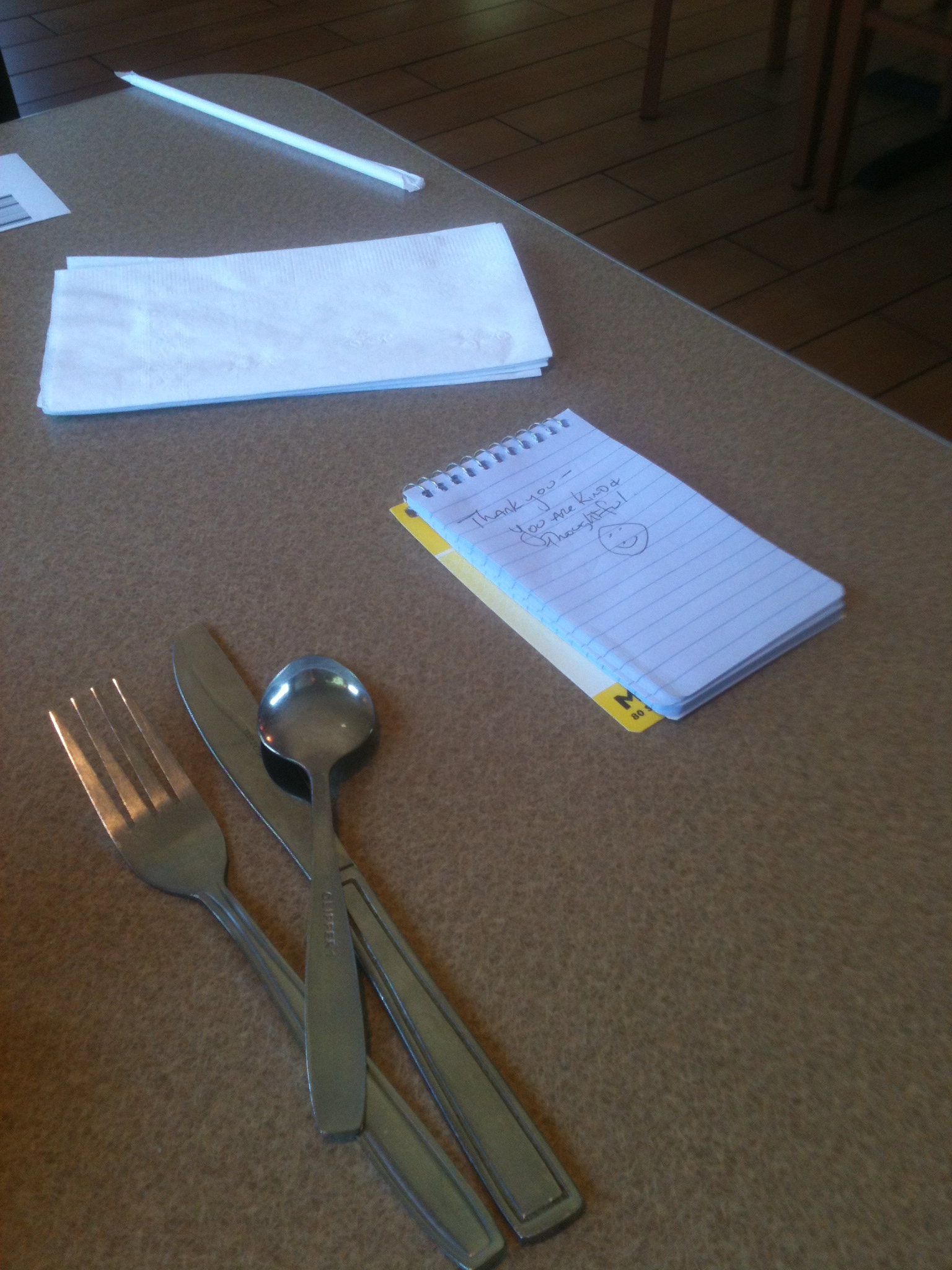
note to waitress

I often use Denny’s as my place to pause and think or write.  On a recent day, I experienced a quiet thoughtfulness that speaks loudly.

I was there to think and reflect.  The waitress seemed to recognize immediately that the most appreciated service would be minimal attention.  She did not overpower me with her attention, but used it sparingly and wisely. 

I had jotted a few notes on the back of a napkin while waiting for my order.  After it arrived, I bowed my head for a short prayer and when I looked up there was a notepad and pen next to my knife and fork.  She had noticed and she acted without a formal request and without fanfare.  That is service…whether in a restaurant, or in an office or at home.  Serve by noticing, not only by request or in hopes of some “exchange” of money, favors or power.  Just serve.  

I had a small notebook in my pocket (the one in the photo) so I really didn’t need what she had provided, but her subtle attentiveness was the sort of re-affirmation about kindness that I needed at the moment.  So, in addition to a healthy tip, I left her a note.  It simply said, “Thank you.  You are kind and thoughtful.” and included a smiley face.

Serving is a wonderful thing, as is thanking.  Take the time to do either or both.  It is the least we can do for each other.


Whispers from the past; whispers from a distance

I recently completed the trip of a lifetime; one that I have planned and considered for 40 of my 58 years. I went to Mississippi. Whispers brought me there, and whispers came home with me.

Listening to life means attending to whispers, silence and shouts.

My dad was born not far from the toe tip of the Appalachians just over 101 years ago. Since about 1974, I have considered a trip to see, write about and photograph the area from where dad came, and the conditions from which he came. I met some kin in 1971, and grew up on stories, and took a Southern literature to better understand that part of my roots through dad’s life. As time passed, the curiosity became a yearning. The pull to go, to see, to meet and to record in words and images comes from a place deep within. It comes from what I am made of, not just from where my dad started life. Very little from then is like it is now, but I found a quote attributed to William Faulkner: “To understand the world, you must first understand a place like Mississippi.”

I had the benefit of seeing my family tree differently. There is no way to see all the details of my heritage, just like it is impossible to see every leave, twig, branch, root, tap root and every inch of bark on a tree; it is quite possible to stand from a distance and see the tree, causing one to think, “That is a noble tree.” I saw more of the McInnis tree; it is a noble one.

Dad’s gravestone reads, “He left for us a most noble pattern.” His example was not perfect; welcome to the human race. He comes from a long line of noble, imperfect, hard-working, never-quit, heroic people who are both saints and sinners. My McInnis tree-just like the other trees that comprise the forest of my lineage-is full of adventure, broken branches, marvelous canopies, tree houses, imaginative play…and rings indicating the trying times as well as the good ones. Trees keep the indicators largely hidden, as do people.

The trip provided me the chance to see the trees more clearly and sufficiently to better appreciate them. I have no intention of trying to learn every detail; I learned enough to appreciate the nobility of the efforts put into never surrendering, and into living life fully, heroically and genuinely.

I saw by listening. To stories shared in bits and pieces. To stories shared in cemeteries and porches. To laughter. And to whispers. I will bring it all home, including the whispers.

For decades, I heard whispers from my past, and from a distance, beckoning to come, to see, to listen and to pay attention. I don’t know if I understand the world better because I am trying to understand Mississippi, but I do understand me better. I bet you have a place like that, too.


~~~~~~~~~


Enjoy a sampling of photos, too.

Recognizing Roots

Walking the grounds of the marina at Houston County Lake to create photos seemed the perfect pause to reflect on “Life, Phase Three,” which is the term that I use for life after retirement from higher education.  That rain would chase me back to the cabin to write and relax is all the more perfect.

The first time that I visited the lake was 45 years ago.  In this one place, I have perspectives on a significant part of my life. Of the five other people that I came to the lake with 45 years ago, three have passed away.  Time is fleeting, whether is measured in decades or between thunderstorm outbreaks. Time is precious.  And life is to be experienced with joy, love and purpose.  Sometime the purpose is bold, sometimes sublime.

My “new” life of writing, public speaking, photography and coaching/mentoring had its roots decades ago, even before my first trip to this place.

All this to say, that we should pay attention to the roots that form in life; some feed us, and some are tap roots.  It serves us well to look at our lives and consider the things that nourish us and those that stabilize us.  We should look through the depth and breadth of our lives; the answers are always there.  We can also recognize places to return to in order to pause, recharge and re-direct.

Long live the all-too-short journey!

Love Completely

As one would expect, there has been a lot of talk about fathers this week in the media, on talk radio and in other venues.  I listen.  And I smile at some of the stories as I consider my dad (and mom…both helped define for me what it means to be a dad) and how he matched up to what people say today are examples of a “good father.”

He wasn’t at every event of mine…

He couldn’t drop whatever he was doing to attend to my needs…

He had demons to battle and he wasn’t perfect….

He wasn’t a perfect communicator…

But…

He loved me unconditionally and was fiercely loyal to his family.

The lesson that I gleaned over the years was “love completely and do your best at everything else.” 

For all the things that writers, bloggers, counselors and talk show hosts say about the right way to be a good dad, sometimes coming across as know-it-alls, I just smile and think of dad.  He didn’t “know it all.”  He loved completely and otherwise did his best.  How could I have asked for more?

Happy Father’s Day to all.  Love ya dad (1913-1982).

Finding Normal

While watching the movie Finding Normal, its overlying, underlying and interwoven messages touched me.  At its simplest form, it reminds us all that we have to understand what is “normal” for us, and find it.  And once we find it, we should stay there.

Throughout life we are given clues, be they from tests, people’s comments or our gut instincts.  It serves us well to pay attention to them.  “Normal” means to be comfortable in our own skin, being who we are as best we can.

I posted on Facebook a few weeks ago that I have not felt as comfortable in my skin as I do now for decades.  That is “finding normal.”  At a recent meeting of the Houston chapter of the National Speakers Association, an attendee said to me, “You sound like a preacher.”  I smiled and replied, “I am an INFP!” in reference to the Myers-Briggs profile system (the woman who made the comment is a Myers-Briggs expert).  That is “finding normal.”  And I often remember the results of a test taken sophomore year in high school—a LONG time ago—that Fr. Tynan presented:  I need to have five things—power/authority to implement my ideas, enough money to do the things I want, an aesthetic environment, opportunities for creativity, and a situation where people seek my counsel and assistance.  It was true in 1972, and it is true now.  It has been decades, but I have those conditions again.  I have re-found normal.

Have you listened to the signals and clues that you have received over the years?  Have you listened to your instincts?  Do you take actions, think thoughts, dress, eat, laugh, play, dance, create, cook, woodwork, write….what is normal for you?

Finding normal means only that you listen to yourself and your Self, and then choose to live your life there.  Listen.  Find normal. Stay.

Share a Story on Mother’s Day

It has been almost 20 years since I have been able to call or see my mom on Mother’s Day, but not a day goes by that I am not thankful for her being the mother that she was.  Her gravestone reads “A tender mother and a faithful friend.”  No truer words could be spoken.

Today we celebrate moms:  past, present and in-the-making.  We celebrate their qualities and quirks.  We call or get together to share the day with mom.  Do we share our thoughts, too?

Breakfast with mimosas is wonderful, as are roses and sweet cards.  All-hands-on-deck meals to celebrate mom can be magic and fun.  Amidst the good food and laughter, share thoughts:  remembrances of good times, stories of fun and foolishness, and inner thoughts of what it means to have the mother you have.  This is not a day to pick at a scab of some irritation—all families have them—but to share thoughts and feelings about life as a child to your mom.  For young mothers, husbands could share stories of the life that is to be.  Share, share…and one of the best ways is through stories.

Each day I wonder aloud and measure myself against whether I have done as much as possible with the gifts that my parents gave me:  love, support, courage, and the ability to be and to express myself.  If mom were here, I’d share some stories of the ways that she had done that for me.

It’s Mother’s Day. Share a story along with hugs, laughter and love.  She’ll know then how well she has done.